
 YouYoung Seo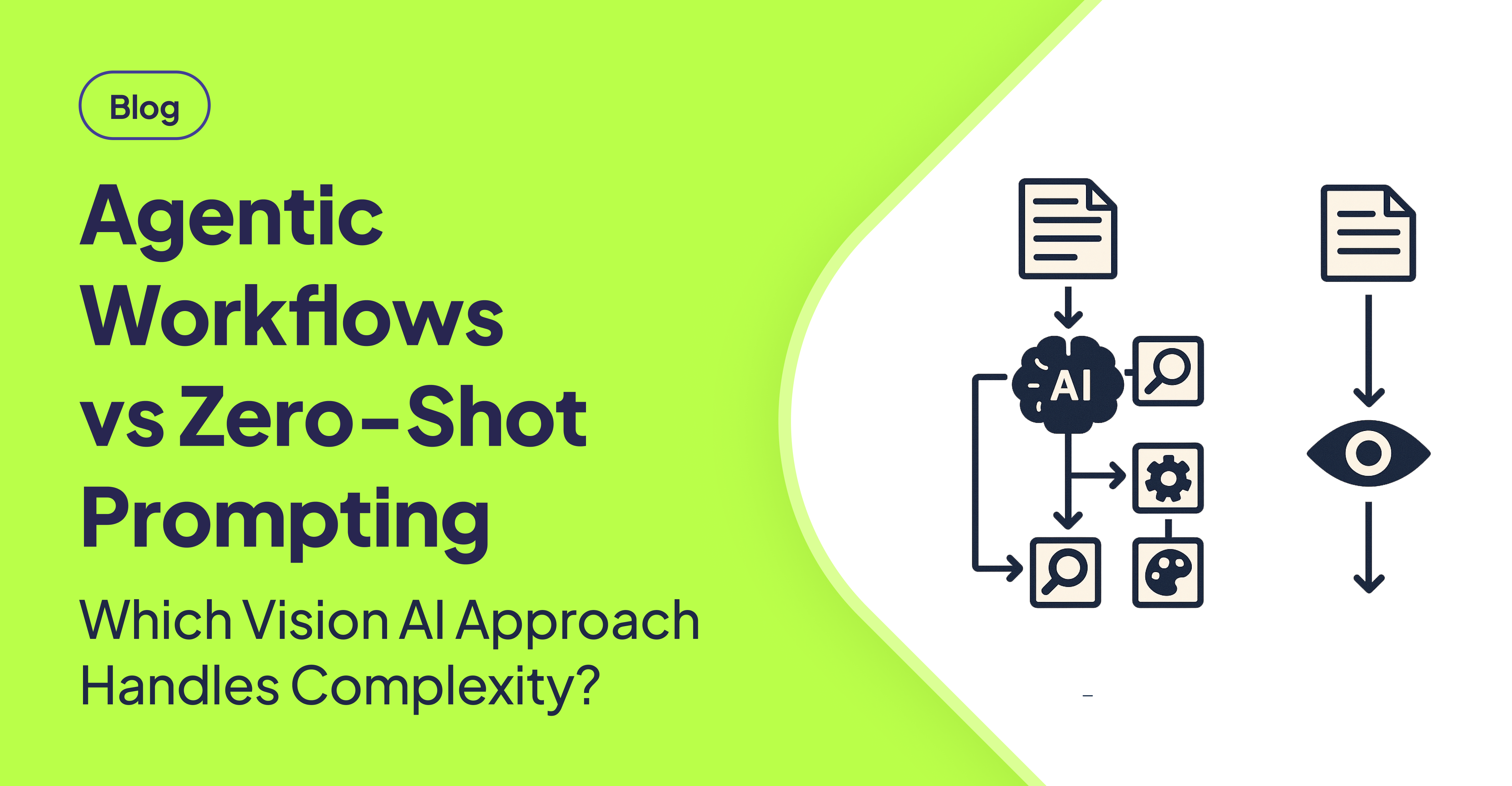
TLDR
Agentic Workflows excel in complex Vision AI tasks that require reasoning and the use of specialized tools, as they break down problems into manageable subtasks and iteratively refine outputs. Zero-Shot Prompting, on the other hand, is more suitable for rapid prototyping and simple visual tasks where quick deployment and minimal complexity are key, although it may struggle with accuracy and complex reasoning.
Introduction
Agentic Workflows and Zero-Shot Prompting represent distinct approaches within the field of Vision AI. Agentic Workflows address complex tasks by dividing them into smaller, more manageable subtasks, leveraging specialized models for each component, and iteratively refining outputs to mimic human problem-solving. Conversely, Zero-Shot Prompting employs a single natural language prompt without requiring task-specific training. This comparison aims to highlight the strengths, limitations, and ideal use cases for each approach, providing valuable guidance for your Vision AI strategy.
The Power of Agentic Workflows in Vision AI
Agentic Workflows function by disassembling complex vision tasks into smaller, more manageable subtasks. This method allows for the use of specialized models for each component, iteratively refining outputs for optimal results. Agentic workflows mimic human problem-solving strategies, offering several key benefits:
- High Accuracy: By focusing specialized models on specific subtasks, Agentic Workflows enhance overall precision in complex tasks.
- Advanced Reasoning: Agentic Workflows support intricate visual problem-solving that requires multi-step logic and contextual understanding.
- Scalable Solutions: Agentic Workflows are designed to handle large-scale Vision AI tasks efficiently, making them ideal for enterprise applications.
Agentic workflows mirror how humans decompose and solve complex visual problems.
Key Advantages of Agentic Workflows
Handling Complexity and Multi-Step Logic
Agentic Workflows are particularly well-suited for tasks requiring complex reasoning and multi-step logic.
- Ideal applications include scene understanding, object tracking, video analysis, and real-world industrial Vision AI tasks.
- Supports sequential decisions and contextual reasoning, enabling more nuanced and accurate analysis.
Adaptability Through Specialized Models
One of the most significant strengths of Agentic Workflows is their adaptability through the integration of specialized models.
- Seamlessly integrates segmentation, tracking, object recognition, and domain-specific tools.
- Quickly adapts to incorporate new models and algorithms, ensuring the system remains up-to-date.
Continuous Learning and Iterative Refinement
Agentic Workflows utilize continuous learning through planning, execution, and evaluation loops.
- Refines outputs for progressively higher accuracy over multiple cycles, improving performance over time.
- This iterative process helps the system learn and adapt to new challenges.
Enterprise-Level Scalability
Agentic Workflows are designed to efficiently process massive image and video datasets.
- Suitable for high-volume pipelines, making them production-ready for enterprise-level deployments.
- Ensures consistent performance even when dealing with large datasets.
Potential Limitations of Agentic Workflows
- Prompt Engineering: Requires precise and structured task definitions to guide the workflow effectively.
- Tool Dependency: The performance of the workflow is heavily reliant on the performance of the third-party models it integrates.
- Computational Cost: Due to their multi-step logic, Agentic Workflows can be more resource-intensive than other approaches.
Understanding Zero-Shot Prompting in Vision AI
Zero-Shot Prompting involves providing a single natural language prompt to a pre-trained model, without any task-specific training. The model attempts to generate a solution based solely on its existing knowledge.
Benefits of Zero-Shot Prompting
- Simple and fast to deploy, making it an excellent choice for rapid prototyping.
- Ideal for early-stage prototypes or lightweight visual tasks where speed is a priority.
- Requires minimal setup and engineering overhead, reducing the initial investment.
Drawbacks of Zero-Shot Prompting
- Often exhibits poor performance on complex reasoning tasks that require multi-step logic.
- Struggles to effectively integrate specialized tools, limiting its capabilities in specialized domains.
- Carries a higher risk of producing hallucinated or generic outputs, affecting reliability.
Agentic vs. Zero-Shot: A Comparative Analysis
| Aspect | Agentic Workflows | Zero-Shot Prompting |
|---|---|---|
| Complexity Handling | Excellent | Weak |
| Specialized Models | Fully Integrates | Not Available |
| Iterative Refinement | Continuous | Single Attempt |
| Computational Cost | High | Low |
| Deployment Speed | Slower | Immediate |
| Accuracy on Complex Tasks | High | Low |
| Suitable Use Cases | Production, Enterprise, Complex Pipelines | Prototyping, Lightweight Tasks |
Real-World Applications: Agentic Workflows vs. Zero-Shot Prompting
| Use Case | Agentic Workflows | Zero-Shot Prompting |
|---|---|---|
| Object Tracking | ✅ Decomposes frame logic for accurate tracking | ❌ Struggles with temporal tasks and complex scenes |
| Scene Understanding | ✅ Combines tools for in-depth scene analysis | ❌ Produces shallow summaries with limited detail |
| Initial Labeling | ❌ Overkill for basic labeling tasks | ✅ Quick and easy for initial dataset exploration |
| Industrial Visual Inspection | ✅ Enterprise-grade solution for reliable inspections | ❌ Limited capability for complex industrial scenarios |
Choosing the Right Approach for Your Needs
| Scenario | Recommended Approach |
|---|---|
| Complex multi-step vision tasks | Agentic Workflows |
| Real-time enterprise pipelines | Agentic Workflows |
| Simple, quick visual experiments | Zero-Shot Prompting |
| Limited computational infrastructure | Zero-Shot Prompting |
Conclusion
Agentic Workflows are the preferred choice for complex, production-level Vision AI applications because of their capacity to reason, iteratively improve, and integrate specialized tools. Zero-Shot Prompting is most effective for rapid prototyping and simple visual tasks where quick setup and minimal complexity are essential. While Zero-Shot Prompting has its place in initial exploration, Agentic Workflows are generally necessary to ensure real-world reliability in Vision AI deployments.
FAQ
What are the main differences between Agentic Workflows and Zero-Shot Prompting?
Agentic Workflows break down complex tasks into smaller subtasks, use specialized models, and iteratively refine outputs, making them suitable for complex, production-level applications. Zero-Shot Prompting uses a single natural language prompt without task-specific training, ideal for quick prototyping and simple visual tasks but less accurate for complex problems.
When should I use Agentic Workflows over Zero-Shot Prompting?
Use Agentic Workflows when you need high accuracy and complex reasoning for tasks like object tracking, scene understanding, and industrial visual inspection, especially in enterprise-level applications requiring robust and reliable performance.
Are Agentic Workflows more computationally expensive than Zero-Shot Prompting?
Yes, Agentic Workflows generally require more computational resources because they involve multiple steps and specialized models. This can lead to higher infrastructure costs compared to the simpler Zero-Shot Prompting approach.
Can I integrate new models and algorithms more easily with Agentic Workflows or Zero-Shot Prompting?
Agentic Workflows are designed to adapt and integrate new models and algorithms more readily. Their modular structure allows for the seamless incorporation of specialized tools, while Zero-Shot Prompting lacks this flexibility.
Is prompt engineering important for both Agentic Workflows and Zero-Shot Prompting?
Yes, prompt engineering is crucial for both methods, but it's especially critical for Agentic Workflows. Precise and structured task definitions are needed to guide the workflow effectively. Poorly defined prompts can significantly reduce the performance of Agentic Workflows.