
 YouYoung Seo
TLDR
Rule-based automation was always going to hit a wall. It can only cover the paths someone thought to write a rule for, and reality doesn't stay inside those paths for long. A button gets relabeled. A popup shows up out of turn. None of that means the software broke. It just means nobody scripted for that exact moment.
Most tools respond by adding more rules. An agent that reasons about the workflow does something different: it treats "the screen will look a little off today" as the normal case, not the exception, and keeps going instead of stopping. That's the real shift, and it shows up in something as unglamorous as a compliance record nobody had to sit down and write.
Testing Was Never Really About the Screen
That's the part most teams already feel: tests that pass one week and fail the next for reasons that have nothing to do with a real bug. What gets missed is why. A rule-based test isn't really testing the workflow, login, checkout, whatever the task is, it's testing one specific rendering of that workflow, frozen at the moment someone wrote the script. The screen was always a stand-in for the thing actually being verified, and in our experience that's a big part of why many teams plateau around 40-60% automation coverage: not because there's nothing left to test, but because maintenance becomes the bottleneck.
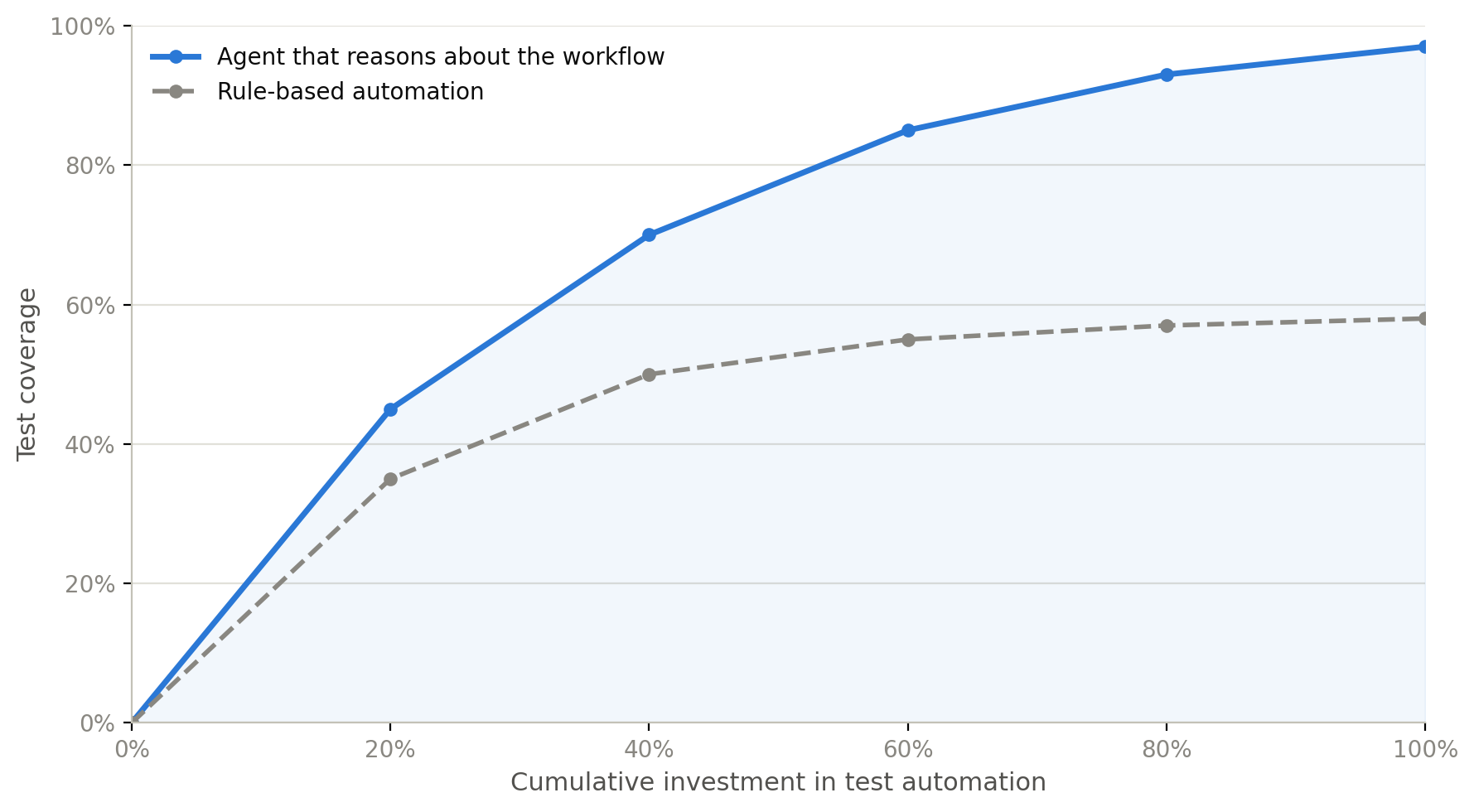
An agent built to reason about the workflow itself doesn't have that dependency. It can do the same verification work regardless of which screen the workflow happens to be running on today, or how that screen looks tomorrow. That distinction matters more as the workflow extends past what a single test script was ever built to check.
The Test Run Is Already an Audit Trail
Once an agent is running a workflow step by step, it's already producing a structured record of what it did. An execution report captures the timestamped sequence of actions, a screenshot at each step, which tool got used, the model's responses, and any errors along the way. That record exists to verify the test, but it's detailed enough to answer a broader question too, not just "did this pass," but "exactly what happened, in what order."
It's also not locked into one format. The same underlying data can be exported as structured logs, sent to a database, or pushed into whatever system a compliance or QA workflow already runs on, rather than living only as a one-off report nobody reads twice.
That's a meaningfully different starting point for compliance work. Under frameworks like CRA (EU 2024/2847) and ISO 26262, audit-ready evidence usually means someone assembles it after the fact: reconstructing what a test covered, when, and with what result. That reconstruction gets a lot harder under a tight clock. The CRA's vulnerability reporting rule takes effect in September 2026: once a manufacturer becomes aware that a vulnerability is being actively exploited, it has 24 hours to file an initial warning. For context, organizations currently take an average of 241 days to identify and contain a data breach in the first place. The metrics aren't identical. One measures full breach containment, the other measures time to first report. But the gap in response readiness they point to is hard to ignore. Piecing together what a test suite actually verified isn't something that fits inside a 24-hour window if the evidence doesn't already exist. When the test run itself already produces that trace, the evidence isn't a separate task bolted onto testing. It's a byproduct of running the test in the first place.
Why This Is Worth Thinking About Now, Not Later
None of this requires choosing between testing and documentation, or between today's priorities and some future roadmap. It's a property of how the underlying agent works: an agent that reasons about a workflow rather than matching fixed selectors produces a richer record simply by doing its job. That's a different thing from bolting AI onto an existing test runner. A test written in plain language, an agent that reasons through ambiguity instead of breaking on it, and a report that's generated rather than assembled, those aren't three separate features. They're one system built around how QA actually works, not a general-purpose agent pointed at a screen. Teams evaluating a testing approach today are also, whether they think about it this way or not, evaluating how much further that same record can be put to use.
Conclusion
The screen was always a means to an end, a place where a workflow happens to be visible and interactable. Once an agent verifies that workflow directly instead of matching against a fixed sequence of screen interactions, the record it produces along the way turns out to be useful for more than a pass/fail result. That's worth keeping in mind even when the decision in front of you is only about testing.
FAQ
What does "workflow ownership" mean in the context of AI testing agents?
It means the agent's understanding is built around the task, log in, complete a purchase, verify a value, rather than around a fixed sequence of screen interactions. The screen is where that task happens to be represented today. If the interface changes, the agent's understanding of the workflow doesn't have to start over.
How does a test run become useful for compliance documentation?
An agent that reasons through a workflow step by step naturally produces a structured trace of what it observed, decided, and did, with timestamps. That trace can support the kind of audit-ready evidence teams in regulated environments often need, generated as part of running the test rather than assembled separately afterward.
Does this mean I need more than basic test automation to get value?
No. Agentic test automation that verifies a workflow instead of matching fixed selectors is useful on its own, coverage that holds up as the UI changes. The richer execution record is a property of how that agent works, not a separate feature you need to adopt on top of it.
How does this relate to compliance requirements like CRA or ISO 26262?
Audit-ready documentation under these frameworks traditionally means someone writes up evidence after the fact. When the same agent that runs the test also produces a detailed execution trace, that trace can serve as part of the documentation directly, rather than requiring separate manual assembly.